
Air Conditioners on Amazon: Window Unit vs. Floor Unit Explained
Explore the various air conditioners available on Amazon and the real differences between a window unit and a floor unit before you buy.

Amazon carries dozens of air conditioners across at least four main categories: window units, portable floor units, through-the-wall units, and ductless mini splits. The two most popular options for renters and homeowners alike are window units and portable floor units, and they are more different than they look on a product listing. Window units are more efficient, quieter, and better at cooling larger spaces, while portable floor units win on flexibility and renter-friendliness. Knowing which trade-off actually matters for your situation is the whole point of this article.
Key takeaways
- Window AC units are roughly 15-38% more energy efficient than portable floor units of the same BTU rating.
- Portable floor units cost $90-$500 and are renter-friendly, but deliver 30-50% less actual cooling than their labeled BTU suggests.
- Window units can cool rooms up to 1,250 sq ft at the top end; most portable units top out at 700 sq ft.
- Over a full summer, a window unit typically saves $50-$150 on electricity compared to a comparable portable model.
- Top Amazon AC brands include Midea, LG, BLACK+DECKER, Whirlpool, Hisense, and Honeywell across both unit types.
On this page
- What Are the Various Air Conditioners Available on Amazon?
- How Does a Window Unit Actually Work vs. a Floor Unit?
- Key Facts to Know Before You Buy
- Stats and Data: Window Unit vs. Floor Unit by the Numbers
- Practical Tips for Choosing and Using Your AC
- Myths vs. Facts
- Frequently Asked Questions
- The Bottom Line
What Are the Various Air Conditioners Available on Amazon?
All right, before getting into the window-vs-floor debate, it helps to know what categories are actually on the table. Here is what you will find when you search Amazon for air conditioners:
- Window air conditioners: A single box that mounts directly into a window frame. The compressor sits outside, the cooling side faces into the room. Brands like Midea, LG, Whirlpool, and Hisense dominate this category on Amazon.
- Portable floor units (PACs): A freestanding unit that sits on the floor inside the room and vents hot air out through a hose connected to a window kit. BLACK+DECKER, Honeywell, and LG are among the most frequently purchased on Amazon.
- Through-the-wall units: Similar concept to a window unit but installed through an exterior wall rather than a window opening. Less common, but available from brands like OLMO on Amazon.
- Ductless mini splits: A two-piece system with an indoor air handler and an outdoor compressor connected by refrigerant lines. Higher upfront cost and professional installation required, but the most efficient option of the group. COSTWAY and Senville offer DIY-friendly versions on Amazon.
- Evaporative coolers: These use water evaporation rather than a compressor and refrigerant. Effective only in dry climates. The Evapolar evaCHILL is a popular small-desk version on Amazon.
So for this article, the focus is on the two you are most likely comparing: window units and portable floor units.
How Does a Window Unit Actually Work vs. a Floor Unit?
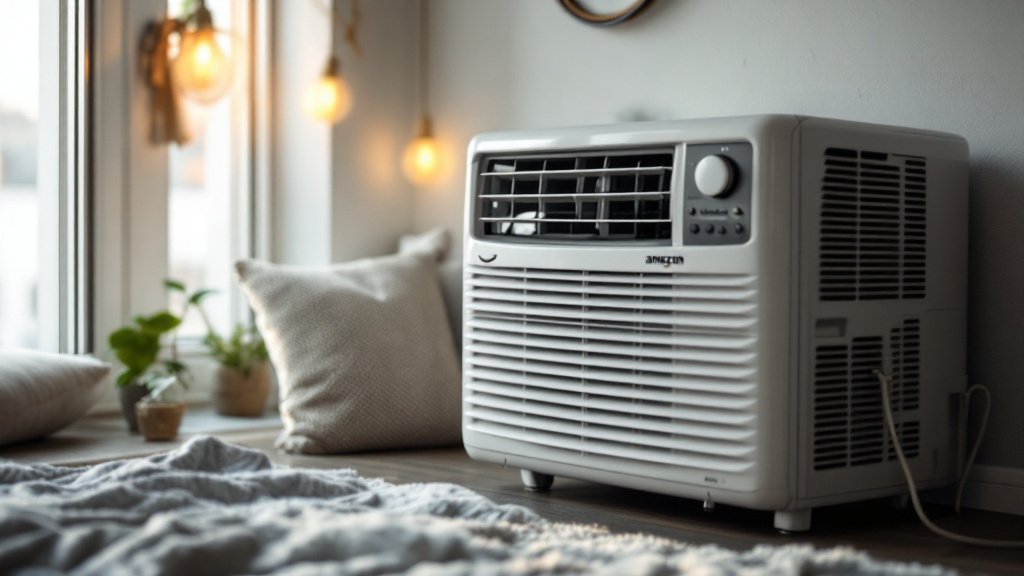
A window unit is a single box mounted directly in the window frame, with the compressor sitting outside and the cooling side facing into the room. A portable unit sits on the floor inside the room and vents hot air out through a hose connected to a window kit, so nothing is permanently mounted in the window itself.
That difference in where the compressor lives matters more than it sounds. Window units are known for their high Energy Efficiency Ratio because the entire hot side of the compressor sits outside, meaning they require less electricity to drop the indoor temperature. A portable unit, by contrast, has to work against itself: the compressor generates heat inside the room it is trying to cool, and then exhaust some of that heat back out through a hose. That is why it is important to make sure the ventilation tube is as short as possible, because the smaller the surface area of the tube, the less heat will be able to recirculate before getting blown outside.
A portable unit sits on the floor and vents warm air through a hose to a window, while a window AC is installed directly in the window frame. Portable ACs are easier to move and install, but window units typically cool more efficiently because they do not lose conditioned air through the exhaust hose.
Key Facts to Know Before You Buy
BTU and Room Coverage
BTUs, or British Thermal Units, are the standard unit of measurement for the cooling power of an air conditioner: the higher the BTU rating, the faster the unit can cool down a room. This is where window units have a clear structural advantage. Portable ACs have a narrower range of 8,000 to 14,000 BTU, covering 200 to 700 square feet, while window ACs span 5,000 to 25,000 BTU and cover 150 to 1,250 square feet.
There is one thing about portable unit BTU ratings that trips a lot of people up. The DOE found that old single-duct portable AC efficiency ratings were significantly overstated once real-world infiltration losses were accounted for, and their testing showed that a portable AC labeled as 10,000 BTU might deliver only 5,000 to 6,500 BTU of actual net cooling to a room. So when you are comparing window unit BTUs to portable unit BTUs on a product listing, you are not looking at the same measurement in real terms.
Installation
Most portable units come with a window kit that slides into a standard vertical or horizontal window, requiring no tools or permanent changes. You can move the unit from bedroom to living room as needed. Window ACs require mounting brackets, sealing foam, and often a second person to lift and secure the unit. They are semi-permanent and not designed to be moved frequently.
Noise
Portable units run at roughly 55 to 60 decibels, while window AC units tend to run slightly lower at 53 to 58 decibels. The real-world difference is that a window unit has the loudest part of the appliance, the compressor, hanging outside the window, so what you hear inside is mostly the fan. With a portable unit, the entire machine including the compressor is sitting in the room with you.
Floor Space and Renter Considerations
A portable air conditioner occupies floor space and might necessitate rearranging your furniture to accommodate it. In contrast, a window unit is installed directly in the window, keeping it out of your living space. If your lease or HOA bans units hanging outside the structure for safety or aesthetic reasons, a portable AC is your ultimate workaround since the entire unit remains safely inside.
Amazon Pricing Benchmarks
Portable AC units cost roughly $90 to $500, and window AC units cost $150 to $500, making both options affordable alternatives to central air. On the high end, window air conditioners that cover larger square footage have a wider price range, from about $150 to over $800. As a concrete Amazon example, the BLACK+DECKER 8,500 BTU Portable Air Conditioner covers up to 350 square feet and runs around $287. On the window unit side, the Whirlpool 18,000 BTU Window Air Conditioner with Dehumidifier covers large rooms up to 1,000 square feet.
Stats and Data: Window Unit vs. Floor Unit by the Numbers
Here is a clean side-by-side look at the key specifications based on research across multiple sources:
| Metric | Window AC | Portable Floor Unit |
|---|---|---|
| Average EER Rating | 10 | 8.5 |
| Average CEER Rating | 11.96 | 7.5 |
| BTU Range | 5,000 to 25,000 | 8,000 to 14,000 |
| Room Coverage (sq ft) | 150 to 1,250 | 200 to 700 |
| Noise Level (dB) | 53 to 58 | 55 to 60 |
| Typical Price Range | $150 to $800+ | $90 to $500 |
| Estimated Summer Electricity Cost | $52 to $110 | $104 to $173 |
| Energy Star Eligible? | Yes | No |
| Portable Between Rooms? | No | Yes |
Sources: LearnMetrics, EcoCostSavings, EcoThriftHome, Northern Services
Now let us visualize the efficiency and cost difference in chart form. First, the average CEER ratings side by side:
Average CEER Rating: Window AC vs. Portable Floor Unit
Window AC (Average CEER), 11.96
Portable Floor Unit (Average CEER), 7.5
And here is the estimated summer electricity cost comparison using real-world data from EcoThriftHome:
Estimated Summer Electricity Cost (90 Days, 8 hrs/day)
Window AC 5,000 BTU, $52
Window AC 8,000 BTU (Energy Star), $71
Portable AC 8,000 BTU (5,000 SACC), $104
Window AC 12,000 BTU (Energy Star), $110
Portable AC 10,000 BTU dual-hose (7,000 SACC), $115
Portable AC 14,000 BTU single-hose (9,500 SACC), $173
“Window ACs are categorically eligible for Energy Star certification while portable air conditioners are not.” That single fact from Northern Services Today tells you a lot about where these two technologies actually stand.
Practical Tips for Choosing and Using Your AC
Match Your BTU to Your Room Size First
Do this before you even look at prices. Window ACs generally provide stronger, more consistent cooling for rooms up to 400 to 600 square feet, depending on the BTU rating, while portable air conditioners are better suited for smaller spaces, typically covering 200 to 400 square feet. If you have a large open-plan living room, a portable unit is probably not going to cut it. That matters more than any sale price on the listing.
If You Go Portable, Go Dual Hose
If you choose a portable AC unit, invest in dual-hose units. These units have higher energy efficiency than single-hose units and you do not run into negative indoor air pressure problems. A single-hose portable unit creates negative pressure inside the room, which pulls warm outside air through every gap and crack in your walls. That is the design flaw that makes the rated BTU number on the box misleading.
Check Your Window Type Before Ordering a Window Unit
If your landlord permits them and you have standard single-hung or double-hung windows, a window AC is the best choice for keeping utility bills low and saving physical floor space. Casement windows are a different story. Most window AC kits are designed for double-hung windows, and if your apartment has side-crank casements, you are probably looking at a portable unit whether you want one or not.
Seasonal Storage: Think Ahead
Window units that stay mounted all winter can let cold drafts through the seals. If you plan to remove yours each fall, factor in the weight before you buy. Many window units run 40 to 80 pounds, and getting them in and out of the frame alone is genuinely awkward. Portable units are easier here: roll them to a closet, coil the hose, and you are done. The wheel casters are worth paying attention to on the product listing, because cheap ones crack on hard floors.
Smart Features Are Worth Considering
Several Amazon best sellers now include Wi-Fi and voice control. The LG 6000 BTU Window Air Conditioner works with LG ThinQ, Alexa, and Hey Google, and is designed for small rooms up to 250 square feet. Smart features let you pre-cool a room before you arrive home, which matters a lot if you are trying to manage electricity costs. Scheduling is the real value here, not the novelty of talking to your AC.
Myths vs. Facts
Myth: A Higher BTU Portable Unit Is Always Better Than a Lower BTU Window Unit
Fact: Not even close. Consumer Reports’ air conditioner testing found that portables are not nearly as good at cooling as manufacturers claim, and they are pricier and use more energy than similarly sized window units. A portable AC labeled as 10,000 BTU might deliver only 5,000 to 6,500 BTU of actual net cooling to a room. So a 6,000 BTU window unit can legitimately outperform a 10,000 BTU portable in real-world use.
Myth: Portable Units Are Cheaper to Run
Fact: The opposite is true. A window AC uses about 500 to 1,500 watts per hour, while a portable AC uses 800 to 1,400 watts with less cooling output per watt. Over a summer season, a window unit can save you $50 to $150 on electricity compared to a portable model of similar BTU rating.
Myth: Portable Units Do Not Require Window Access
Fact: Almost all compressor-based portable units require a window for the exhaust hose. The most obvious difference between a portable and a window air conditioner is that a window unit is a single box that sits in your window while a portable unit has a box that sits on the floor with an exhaust vent that connects through a window, ceiling, wall, or door. You still need somewhere to vent the hot air. The only true no-window-needed options are evaporative coolers, and those do not work in humid climates.
Myth: Window Units Are Too Loud to Sleep Through
Fact: Because all the mechanicals are sitting in the room with a portable unit, they tend to be noisier than window-mounted units. Some wall-mount units, like the OLMO 8,000 BTU, operate at a noise level of just 52 dB, which is roughly the sound level of a quiet conversation. Portable units running the compressor in the same room where you are sleeping is a real consideration if you are a light sleeper.
Myth: Mini Splits Are Only for Whole-House Systems
Fact: You can buy DIY-friendly mini split units on Amazon that cover a single room. The COSTWAY 12,000 BTU Mini Split Air Conditioner and Heater is WiFi enabled, compatible with Alexa, and covers up to 750 square feet. They require more installation work than either a window or portable unit, but the efficiency payoff over time is significant.
Frequently Asked Questions
What Is the Main Difference Between a Window Air Conditioner and a Portable Floor Unit?
The main difference between a portable air conditioner and a window AC is installation and cooling method. A portable unit sits on the floor and vents warm air through a hose to a window, while a window AC is installed directly in the window frame. Window units are more efficient because the compressor is outside and no conditioned air is lost through an exhaust hose.
Are Portable Floor Units Good Enough for a Bedroom?
If you are cooling a bedroom or home office, a portable unit can be sufficient. The caveat is noise: because the entire compressor runs inside the room, portable units tend to run at 55 to 60 dB, which some light sleepers will notice. If silence matters to you, a window unit or a mini split is the better call.
Can I Use a Window AC Unit If I Am Renting?
For homeowners who rent or cannot modify windows, portable air conditioners are often the only option. That said, many landlords do allow window units as long as no permanent modification is made to the structure. Check your lease first, and if it is unclear, ask in writing. Window unit kits do not require drilling or permanent hardware in most cases.
How Much Can I Expect to Spend on Amazon for a Decent Window AC?
Window units are still affordable at $150 to $500 for most standard sizes. Larger units with higher BTU ratings and smart features push above that. For example, the Hisense 12,000 BTU Smart Inverter Window AC on Amazon advertises 37.6% more energy saving and ultra-quiet operation, and typically falls in the mid-range price tier. Entry-level units for small rooms start below $200.
Is a Dual-Hose Portable Unit Worth the Extra Money?
Yes, if you are committed to a portable unit. A window AC is typically 20 to 30% more energy efficient than a portable AC with the same BTU rating. A dual-hose design closes that gap somewhat by eliminating the negative pressure problem. The most energy-efficient portable AC units, particularly the dual-hose designs, can reach up to an 11.2 EER rating. That is still lower than a typical window unit, but it is meaningfully better than a single-hose unit.
What Top Amazon Brands Should I Actually Consider?
For window units: Midea, LG, Whirlpool, and Hisense are consistently well-reviewed and carry solid BTU ranges. The Midea 5,000 BTU EasyCool is Amazon’s best seller in window air conditioners and cools up to 150 square feet. For portable floor units: BLACK+DECKER and Honeywell cover most use cases, though read user reviews carefully on specific models. For mini splits: Senville and COSTWAY are the accessible entry points on Amazon, with Wi-Fi and inverter technology at a lower price than traditional HVAC brands.
The Bottom Line
All right, so here is where I land on all of this. If you own your space, have standard double-hung windows, and you want the most cooling for the least electricity cost, a window unit wins on nearly every metric. The average CEER for window ACs is 11.96, which is 38% higher than the average for portable units. That is not a marginal difference you can talk yourself out of.
If you rent, move frequently, have casement windows, or need to cool different rooms on different days, a portable floor unit is the practical answer even if it costs more to run. Over a summer season, a window unit can save you $50 to $150 on electricity compared to a portable model of similar BTU rating, which is real money, but it is not the only factor. Your living situation and landlord restrictions matter just as much as the efficiency number.
What I would suggest: start with your actual room size in square feet and your lease terms. Those two constraints will narrow the field faster than any spec sheet. From there, use the BTU-to-square-footage guidelines, look for Energy Star certification on window units, and if you go portable, spend the extra money on a dual-hose model. The listings on Amazon are dense, but once you know what you are actually comparing, the decision gets a lot cleaner.
Sources
- Portable AC Units vs. Window AC Units: Pros and Cons
- Portable AC vs. Window AC: Which One Should You Choose?
- Window vs Portable Air Conditioners: Which Is Right for You?
- Portable AC vs Window AC: Which Is Better? (11-Point Comparison)
- Should I get a portable or window AC unit? – Petro
- The Ultimate Guide to Choosing Between a Portable and Window Air Condi
- Portable air conditioners vs. window AC units: which is best? – Reviewed
- Portable Air Conditioner vs. Window AC: Which is the Best …